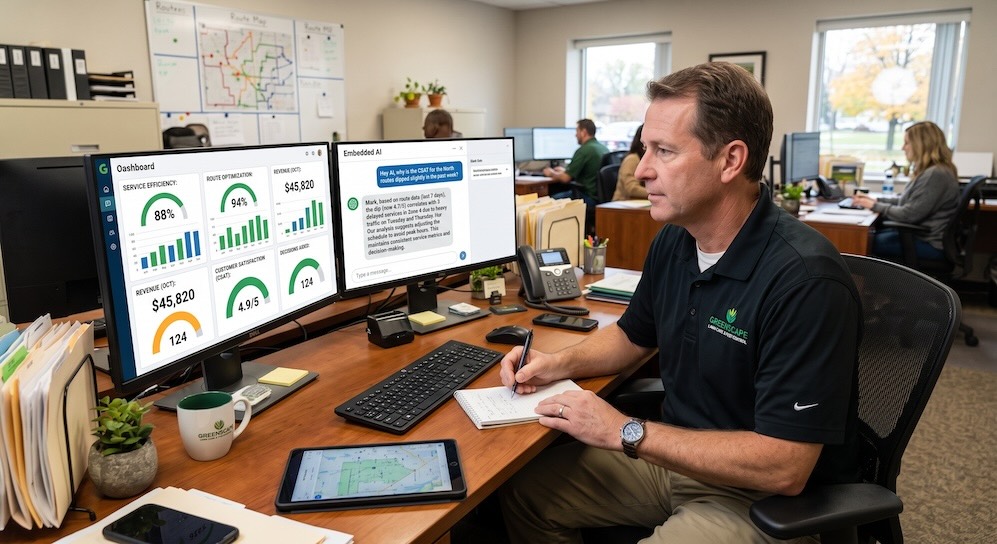
The most dangerous thing an AI assistant can do is not giving you a wrong answer. It is giving you an answer you have no way to check. When you evaluate lawn care or pest control software with AI-powered reporting and analytics, the feature that matters most is not how impressive the answers sound. It is whether the assistant shows its work: the metric it used, the filters it applied and the time window it looked at, in plain language you can verify.
Wrong answers tend to get caught. Sooner or later, someone notices the numbers do not match what is happening in the field and starts asking questions. But an answer with no visible reasoning behind it is much harder to question, because there is nothing to examine. You either trust it or you do not, and neither option is a great way to run a pest control or lawn care business.
What Is the AI Black Box Problem?
The AI black box problem is when a tool gives you a confident answer but hides how it got there. Many AI tools treat their inner workings like a trade secret, even when the "secret" is nothing more than a database query. You ask a question, get an answer and have no idea how the tool arrived at it. Did it look at the last seven days or the last 30? Did it count only completed visits, or cancelled ones too? Without that context, you are left taking the answer on faith.
That might be fine for low-stakes questions. It is not fine for questions like "Are my technicians going to finish their routes today?" or "Which programs are behind on their rounds?" Those answers drive real decisions about where your crews go next.
What Should AI-Powered Reporting in Lawn Care and Pest Control Software Show You?
A trustworthy AI assistant shows its work without making you dig for it. That can be as simple as a short, plain-language note beneath each answer explaining what it looked at. You will not need to read it every time. But knowing it is there whenever you want to double-check changes how much you can trust everything else the assistant tells you.
Before you rely on AI-powered reporting and analytics in any field service platform, check that every answer includes:
- The metric: what was measured, such as completed services, revenue or production per technician
- The filters: which branches, routes, programs or service statuses were included or excluded
- The time window: the exact date range behind the answer
- A visible reminder that the AI can be wrong, shown with every answer rather than buried in the terms of service
Plain Language Beats Technical Detail
What a good assistant should not do is expose the technical machinery underneath. Database names, internal table references and query syntax mean nothing to someone running a branch, and showing them just trades one kind of confusion for another. The plain-language explanation is what matters. Everything beneath it is the builder's job to get right, not yours.
Why a Visible Disclaimer Is a Strength
A trustworthy assistant should also be upfront about the fact that it can be wrong, and not in fine print buried in the terms of service. That reminder belongs in plain sight, every time. It may seem odd to put a disclaimer front and center, but it is actually a strength. The assistant that quietly implies it is always right is the one you should trust the least.
How Do You Know If You Can Trust an AI Answer?
It is tempting to judge an AI assistant by how impressive its answers sound. That is the wrong test. A better one is simpler: Can you verify what it told you? And when it does not know something, does it say so instead of guessing? If you can see the metric, filters and time window behind an answer, you can check it against what is happening in the field before you act on it.
None of that requires a bigger or more powerful model. It requires a builder who deliberately chose not to hide the information you need to check its work. Trust is a design decision. In field service, where one bad answer can cost you a route or an entire day, that choice matters far more than how polished the answer looks.
Whether you run lawn care business software or pest control software, hold every AI feature to that standard. It also helps to understand the difference between data and information, because an AI answer only becomes useful information when your team can see the context behind it.
Frequently Asked Questions
What Lawn Care Software Has AI-Powered Reporting and Analytics?
Several lawn care platforms now offer AI-powered reporting, often as a conversational assistant that answers plain-language questions about revenue, routes and production. When comparing options, look past the feature list and ask whether each answer shows the metric, filters and time window it used, so your team can verify results before acting on them.
Why Is the AI Black Box Problem a Risk for Field Service Businesses?
The AI black box problem happens when a tool delivers a confident answer without revealing how it got there. For a field service business, that means you cannot tell which dates, jobs or filters drove the result. Without that context, you cannot check the answer, so you are left to either trust it blindly or ignore it.
How Can I Tell If an AI Assistant Is Trustworthy?
A trustworthy AI assistant explains each answer in plain language, including what it measured, which filters it applied and the time window it used. It also reminds you, every time, that it can be wrong. When it does not have enough information to answer, it says so instead of guessing.
Should AI Reporting Tools Show Database Queries?
No. Showing database names, table references or query syntax does not help most business owners and branch managers verify an answer. A short, plain-language summary of the metric, filters and time window is far more useful. The technical accuracy underneath is the software builder's responsibility, not yours.