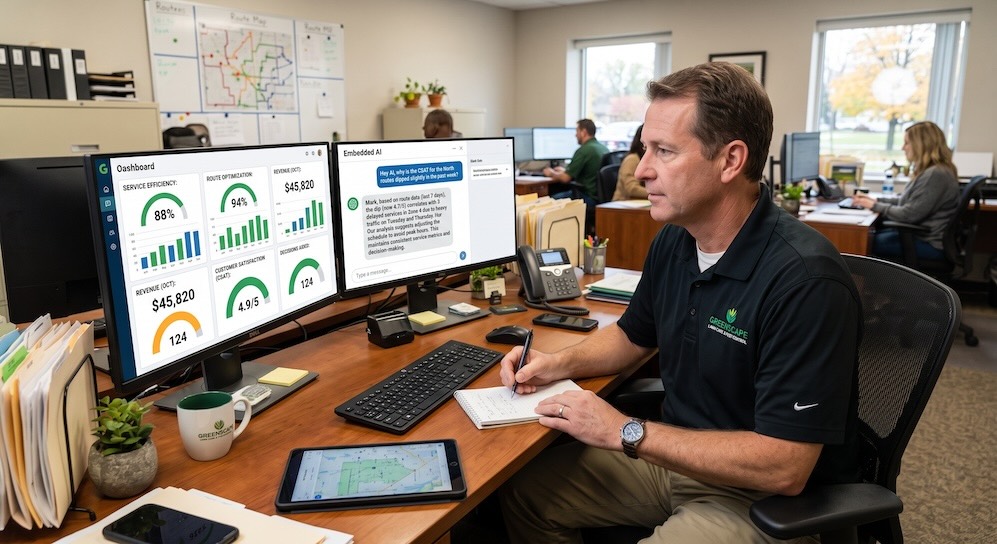
Embedded AI is an assistant built into the software you already use, answering questions with the same data and metric definitions as the screen it sits on. A bolt-on chatbot is a general-purpose AI model wrapped in a chat window. For pest control and lawn care businesses, only embedded AI can guarantee that the number in the chat matches the number on your dashboard.
Every software category is getting a chatbot right now. Open practically any tool you use to run your pest control or lawn care business, and there is a good chance a little chat icon has shown up in the corner sometime in the last year, cheerfully offering to help.
Here is the question worth asking before you get excited about any of them: does it actually know your business, or is it just good at talking?
What Is a Bolt-On Chatbot?
Most of these assistants are built the same way. A vendor licenses a general-purpose AI model, wraps a chat window around it and points it at whatever data happens to be reachable. It can answer questions. It can sound confident doing it. What it usually cannot do is guarantee that the number it just gave you matches the number sitting three clicks away on the report you already trust.
That is not a hypothetical problem. Say your chatbot calculates "callback rate" using a slightly different date window than your dashboard does, or excludes something the dashboard counts. Now you have two versions of the truth in the same software, and no way to know which one is right without checking by hand. That defeats the point of asking instead of clicking.
For field service businesses, where a technician's day gets planned around numbers like completion rate and production per day, that gap costs real time. You end up double-checking the tool instead of acting on it.
What Is Embedded AI?
An embedded assistant works differently, and it comes down to how it is built, not how it looks.
It lives inside the screen you already use, the same hub that shows you technician performance and route completion for the day. When you ask it a question, it answers using the exact same metric definitions that screen already uses. Not an approximation. Not a separate model's best guess at what "on track" means. The same math.
That has one very practical result: the number in the chat and the number on the tab are the same number. Always. There is no second version of the truth to reconcile, because there has only ever been one.
It also means the assistant only knows what it is supposed to know. A chat opened from your Operations Hub sticks to operations questions (schedule adjustments, workload, technician performance) and says so plainly when a question falls outside that. It will not reach into customer billing data to take a guess at something unrelated. It was never built with the reach to do that. That is a narrower assistant than a general-purpose chatbot promises. It is also a more honest one.
Embedded AI vs. Bolt-On Chatbot: How They Compare
- Where it lives: Embedded AI sits inside the reporting screen you already use. A bolt-on chatbot sits in a separate chat window layered on top.
- Metric definitions: Embedded AI uses the exact same calculations as your dashboards. A bolt-on chatbot may calculate its own version.
- Scope: Embedded AI answers what its screen covers and says so when a question falls outside it. A bolt-on chatbot will attempt any question, whether or not it has the right data.
- Trust: Embedded AI is accountable to the numbers you already run your business on. A bolt-on chatbot asks you to trust a second source.
What Should AI-Powered Reporting and Analytics Do for a Field Service Business?
AI-powered reporting and analytics should help pest control and lawn care owners get answers faster without creating new numbers to verify. The best tools let you ask plain-language questions about production, completion rates, cancellations and technician performance, then answer using the same definitions as your existing reports. If you have to double-check the AI, it is not saving time.
When you evaluate pest control or lawn care software that claims AI-powered reporting, ask these questions:
- Does the assistant use the same metric definitions as my dashboards and reports?
- Is it built into the screens my team already uses, or is it a separate chat window?
- Does it stay within the data it is designed to cover and tell me when a question is out of scope?
- Can it help me spot trends early, such as rising cancellations, callbacks or customer churn?
- Will its answers hold up when I compare them against the report I already trust?
Understanding the difference between reporting and analytics helps here too. Reporting tells you what happened. Analytics, and the AI built on top of it, should help you understand why it happened and what to do next.
Why Embedded AI Matters More in the Field Than Anywhere Else
A generic AI assistant giving you a slightly-off answer in a marketing tool is annoying. The same slightly-off answer about whether a technician is behind on their route is a decision made on bad information, and in both pest control and lawn care, the window to fix that decision is short. A route that does not get corrected today does not wait around for you to double-check the math tomorrow.
The same is true for spotting customers at risk of leaving. If your AI and your dashboard disagree about cancellation or callback trends, you lose the head start that data is supposed to give you. Catching those signals early is what gives you time to re-engage lost customers, or better yet, keep them from leaving at all.
That is the real case for embedded over bolt-on: it is accountable to the same numbers you already run your business on. A bolt-on chatbot is not.
How WorkWave Approaches Embedded AI
This is the thinking behind WAIve Analysis, the embedded AI assistant in Wavelytics. Available through Wavelytics for PestPac and Wavelytics for RealGreen, it answers questions from inside the hub you are already looking at, using the same metric definitions as the reports your team relies on.
The Real Bar for AI in Field Service
The real bar for AI in field service is simple: can you trust it as much as you trust the screen it is sitting on top of? Anything less is just a chatbot wearing your logo.
Frequently Asked Questions
What is the difference between embedded AI and a chatbot?
Embedded AI is built into the software screen you already use and answers with the same data and metric definitions as that screen. A typical chatbot is a general-purpose AI model added on top of software in a separate window. It can sound confident, but its answers may not match the reports you already trust.
What lawn care software has AI-powered reporting and analytics?
Several lawn care platforms now advertise AI features, but not all of them offer AI-powered reporting built on your own operational data. RealGreen customers can use Wavelytics, WorkWave's analytics and decision intelligence platform, which keeps AI answers tied to the same metrics owners already track, such as production per technician and completion rates.
Why do AI chatbots give different numbers than my dashboard?
Bolt-on chatbots often calculate metrics on their own, using different date windows, filters or definitions than your dashboard. Even small differences, such as excluding certain jobs from a callback rate, create two versions of the truth. Embedded AI avoids this by using the exact calculations your reports already use.
How can pest control and lawn care companies use AI to spot cancellation trends early?
AI can surface patterns in cancellations, callbacks and churn faster than manual report reviews, but only if its numbers match your system of record. Look for an assistant built into your analytics that uses the same definitions as your reports, so an early warning is something you can act on right away rather than verify first.
Is a narrower AI assistant better for field service?
Often, yes. An assistant scoped to operations questions, such as scheduling, workload and technician performance, that says so when a question falls outside that scope is more reliable than one that guesses across every data set. For field service decisions with short windows, accuracy matters more than breadth.