In the commercial cleaning industry, data is rarely the problem. You have plenty of it — sitting in your ERP, hidden in spreadsheets, siloed in third-party HR apps or locked away in legacy reporting tools. The problem is access.
For decades, Building Service Contractors (BSCs) have relied on robust but rigid systems. While these tools captured the data, extracting it to make agile, profitable decisions often required a degree in data science or hours of manual manipulation.
At WorkWave, we believe that your data should work as hard as your people. We sat down with Todd Wilkins, VP of Systems and Data at 4M Building Solutions, to get his insights on the shift from traditional reporting to modern Data Warehousing and discuss why industry leaders like 4M are moving away from legacy tools like SAP BI and embracing the flexibility of solutions like Wavelytics Data Factory.
The Challenge: The "Black Box" of Legacy Reporting
For years, the industry standard for reporting has been functional but technically demanding. SAP BI offered power, but at the cost of usability. If you didn't know the specific language or complex architecture, you were often stuck waiting for a specialist to build a report.
The Question: How does the speed to insight compare between traditional corporate setups (like SAP BI) and a modern Data Warehouse?
The Insight:
The difference is the distinction between "reporting" and "intelligence." Traditional tools often require you to build queries from scratch every time. Modern solutions, like Wavelytics Data Factory, utilize a "Star Schema." This means the heavy lifting of data modeling — sorting the "facts" (revenue, hours) from the "dimensions" (who, where, when) — is already done.
Real-World Perspective:
Wilkins notes the friction of the old way: "SAP BI is a great tool if you know how to use it... but it's very technically challenging. It is very difficult to go into SAP BI as a new user and learn how to do any more than just drag and drop... Wavelytics and Snowflake make it much more lightweight."
By removing the technical barrier, businesses can move from spending 80% of their time finding data to spending 80% of their time acting on it.
Breaking Down Silos: The Power of Merging Data
One of the biggest hurdles for growing BSCs, especially those expanding through acquisition, is data fragmentation. When you acquire a company, you inherit their data. Merging that with your core WinTeam data without corrupting your legacy records is a massive headache.
The Question: How do we get a "Single Pane of Glass" view across safety, quality and financials?
The Insight:
A true Data Factory acts as a "Data Warehouse in a Box." It doesn't just hold your ERP data; it allows you to ingest third-party sources (like Google Ads, HR software, or Safety platforms) and join them with your operational data.
Real-World Perspective:
For 4M, this capability was critical during their acquisition phase. They needed to bring acquired data under the 4M umbrella without "messing up" the legacy data in WinTeam.
Wilkins explains the breakthrough: "With the inclusion of the NPS (Net Promoter Score) data, we're able to merge it with our WinTeam data, which before we weren't able to do. We can now look at financial performance and correlation with NPS scores... or Quality Assurance performance versus NPS scores."
This is the holy grail of operations: seeing exactly how customer sentiment (NPS) impacts profitability, job by job.
Democratizing Data: From the C-Suite to the Field
Data that stays in the boardroom doesn't clean buildings. To drive efficiency and reduce time theft, data needs to be in the hands of the Area Managers and District Managers who can affect change daily.
The Question: How do we turn data into action for field managers?
The Insight:
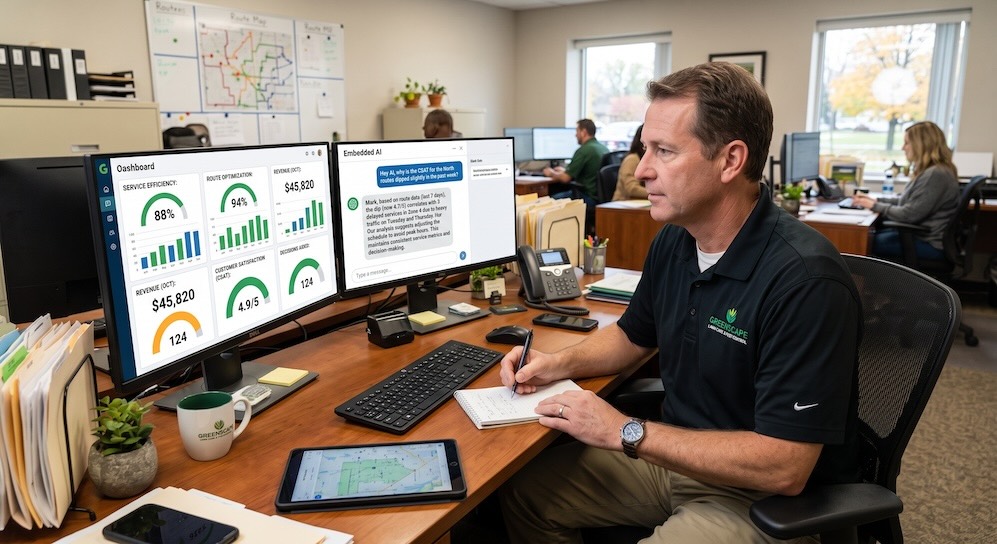
The goal of modern analytics is to move away from static spreadsheets and toward dynamic Scorecards. A scorecard gives a manager a clear, refreshed view of their performance — labor budgets vs. actuals, safety incidents, and overtime alerts — without them needing to run a report.
Real-World Perspective:
4M is using Wavelytics to build these views out.
"What used to be very cumbersome to pull all that together... putting all that into Snowflake and building out a dashboard has really just streamlined the whole process," says Wilkins. "All that manual work that we have to do every month has completely gone away."
When managers have trusted data at their fingertips, accountability rises. The numbers don't lie, and when the data is transparent, the entire organization shifts toward a performance mindset.
The Wavelytics Advantage: Flexibility and Control
Perhaps the most common hesitation we hear from enterprise leaders is the fear of being "locked in" to a proprietary tool.
The Question: Do I have to change my entire tech stack to use this?
The Insight:
No. Wavelytics Data Factory is built on Snowflake, the world's leading data cloud. While we provide the curated pipelines and structure, the data is delivered directly to your environment.
- Bring Your Own BI: Do you love Power BI? Tableau? Sigma? You can plug any of them directly into the Data Factory.
- Rapid Implementation: Unlike custom-built data warehouses that take months, Data Factory typically implements in one week.
Real-World Perspective:
Wilkins highlights this openness as a key win: "WinTeam has not kept the data warehouse closed... We have also experimented with querying into the data warehouse itself from other tools. They are not restricting you to using just one tool... and they've been very helpful in enabling us with that."
Conclusion: The Future is Data-Driven
The transition from legacy reporting to a modern Data Factory is not just an IT upgrade; it is a fundamental shift in how you operate your business.
By adopting Wavelytics Data Factory, 4M Building Solutions moved from manual, monthly report generation to automated, daily insights. They bridged the gap between financial data and operational reality, allowing them to scale their acquisitions and empower their field managers.
The bottom line: You cannot improve what you cannot measure, and you cannot measure what you cannot access.
If you are ready to stop wrestling with spreadsheets and start uncovering the profit hidden in your data, it is time to look at the factory floor.
Ready to unlock the power of your data?
Get in touch today to see how Wavelytics Data Factory can transform your operational efficiency.